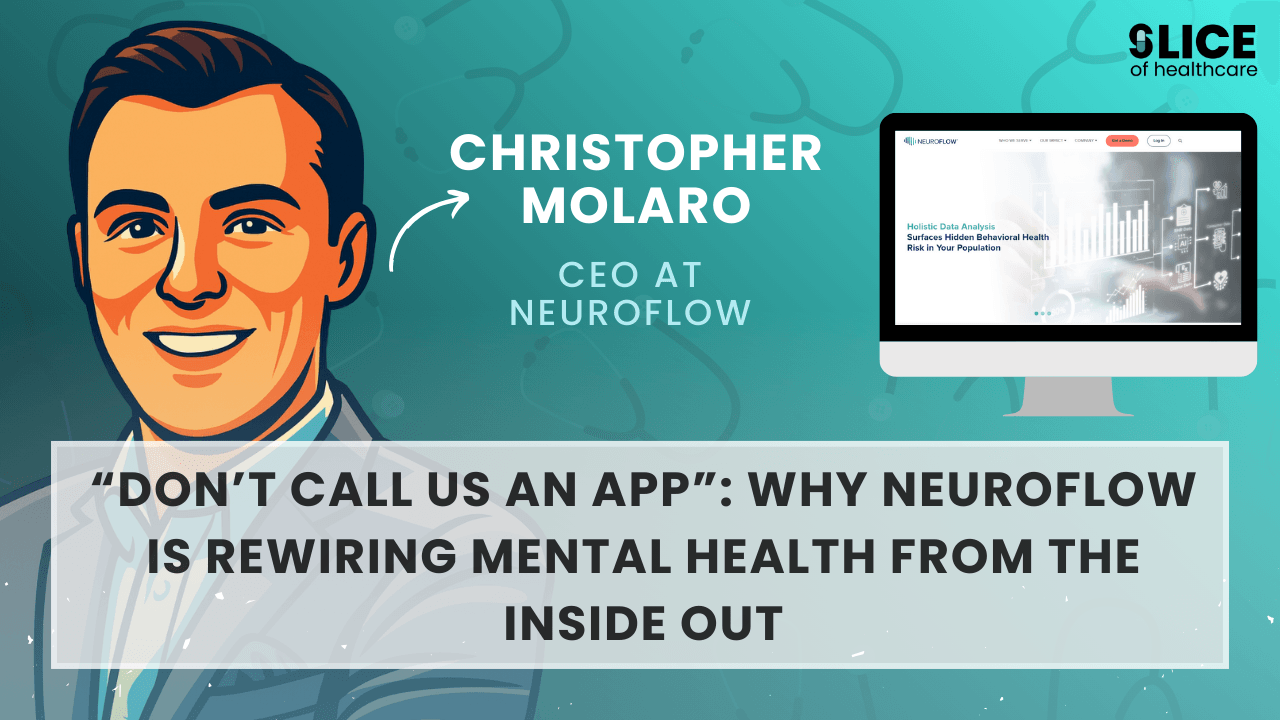
“Don’t Call Us an App”: Why Neuroflow Is Rewiring Mental Health From the Inside Out

Slice of Healthcare Team
08/27/2025


Introduction
Christopher Molaro didn’t come from healthcare or tech. But his experience as an Army officer showed him firsthand what happens when mental health support fails. Now, as CEO of Neuroflow, he’s scaling a quietly revolutionary system that doesn’t just treat mental health—it makes it impossible to ignore.
What Neuroflow Actually Does
Neuroflow is a behavioral health platform that helps health systems, insurers, and the federal government identify and manage mental health risks. Not by providing care directly, but by enabling the people who do.
At its core, Neuroflow runs advanced analytics across messy healthcare data (like claims and electronic health records) to flag behavioral health needs early. From there, it coordinates care and tracks whether it actually helps, closing the loop that too often gets left open.
This isn’t an app trying to change the world. It’s infrastructure for making mental health impossible to overlook.
From Artillery to Algorithms: How It Started
Before he was a CEO, Chris Molaro was an Army officer. He led soldiers in combat. He saw them struggle, often silently, with PTSD, sleep issues, and trauma. He struggled too.
When he left the military and enrolled at Wharton, he knew he wasn’t done serving. “I wanted to be a part of something bigger than myself,” he said. “And I realized that the gaps in mental health care were not addressed appropriately. What did I have to lose?”
That question led to Neuroflow, co-founded with a bioengineering PhD at Penn. They’ve been building ever since.
Why Neuroflow’s Approach Matters
The industry kept trying to make Neuroflow “an app.” And to be fair, it does have one.
But Molaro bristled at that label. “If they think you are an app, getting them to change that notion is very difficult,” he said. It limited who they could reach. Not everyone has a smartphone or trusts one.
So they rebranded. Now the app is called Onward, just one engagement tool among many. SMS and email are in the mix too. And for some customers, like the VA, there’s no app at all.
What’s taken its place? A new tool called BHIQ that doesn’t rely on user engagement at all. It mines existing data to find mental health risks and prompts follow-up, even when the patient never downloads a thing.
The shift has been seismic. “We’re now embedded in workflows where the end user doesn’t even know they’re interacting with Neuroflow,” Molaro said. And that’s the point. Behavioral health isn’t a standalone problem. It touches everything from OB-GYN to oncology. It should be everywhere.
Who Neuroflow Reaches
Today, Neuroflow supports 17 million people across all 50 states. They work with payers, hospital systems, and the federal government, including the VA.
And they’re expanding into specialties like women’s health and chronic disease, where mental health often goes untreated. Think postpartum depression, anxiety in cancer patients, or the psychological toll of diabetes. Untreated mental health makes everything else worse, and Neuroflow makes sure it gets noticed.
Real Talk: Why Molaro Keeps Building
Molaro has had family members struggle with depression and substance use, badly. Despite being deep in this industry, even he couldn’t always get them the support they needed.
“That’s embarrassing,” he said, not for them, but for a system that still makes it that hard. “There are tens of millions of people that struggle silently. And the tragedy is, they don’t have to.”
The resources exist. What’s missing is connection. That’s what Neuroflow is building: the connective tissue that routes people to real help, at the right time, through the systems they already use.
What’s Next
Forget point solutions. “They’re dead or dying,” Molaro said. Neuroflow is going all in on seamless integration. No new apps. No extra work for providers. No workflow disruption.
That means more people helped, faster. And less room for anyone to fall through the cracks.
Expert Insights
Share Your Expert Insights
Have relevant experience or professional perspective? Add your thoughtful insights to this article.