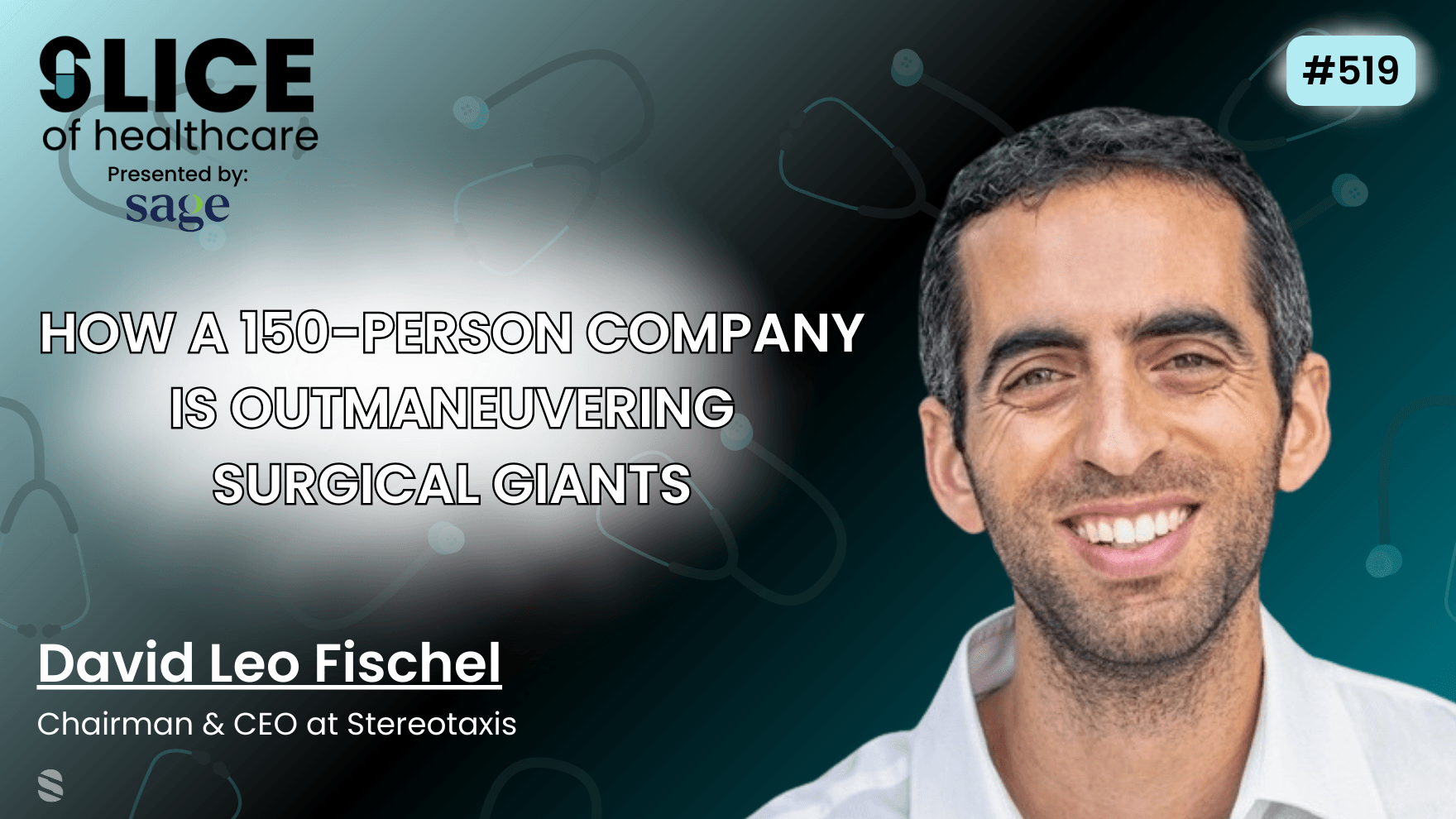
#519 - David Leo Fischel, Chairman & CEO at Stereotaxis

Slice of Healthcare Team
09/10/2025


Guest
Episode details
Join us on the latest episode, hosted by Jared S. Taylor!
Our Guest: David Leo Fischel, Chairman & CEO at Stereotaxis.
What you’ll get out of this episode:
- Next-Gen Surgical Robotics: Stereotaxis pioneers the only commercial robotic system for endovascular procedures, revolutionizing catheter-based interventions.
- Precision with Magnetic Fields: Their unique approach uses magnetic fields for millimeter-level control of catheters deep inside the body.
- Focused Innovation: The company is investing heavily in improving accessibility, catheter design, and AI-driven clinical intelligence.
- Breaking Barriers: Stereotaxis is tackling both societal and mechanical limitations that have historically hindered robotics in vascular surgery.
- Platform Potential: CEO David Fischel envisions Stereotaxis as a foundational platform for a broader spectrum of procedures, similar to Da Vinci in laparoscopic surgery.
Watch
Listen
Read More
Stereotaxis: Engineering the Future of Cardiac Care
In the world of minimally invasive surgery, few companies are pushing boundaries like Stereotaxis. Led by Chairman & CEO David Leo Fischel, this St. Louis based medical robotics firm is pioneering advancements in robotic-assisted endovascular surgery, a field long overdue for disruption.
With over 150,000 patients treated across 100 hospitals globally, Stereotaxis has built its name on precision and innovation. Unlike traditional robotic surgery platforms, which rely on mechanical manipulation, Stereotaxis deploys magnetic fields to guide ultra-thin catheters with unmatched accuracy inside the human body. This allows for delicate procedures in hard-to-reach areas like the heart and brain, all without direct human hand control.
“ “We place tiny magnets in the catheter tip,” explains Fischel. “Then we move the catheter using magnetic fields with millimeter precision. It bypasses the instability you get from manual handling.” ”
Why Robotic Surgery? Why Now?
Fischel makes a compelling case: robotic surgery enhances the surgeon's cognitive focus while minimizing the need for advanced hand-motor skills. This not only improves precision and patient safety but also democratizes surgical outcomes by reducing variability across skill levels.
While robots like the Da Vinci system have transformed open and laparoscopic surgeries, endovascular surgery, which involves procedures conducted via blood vessels, has remained largely untouched by robotic innovation. Stereotaxis is filling that gap.
Three Pillars of Innovation
Looking ahead, the company is betting big on three core innovation areas:
- Accessibility: Creating plug-and-play robotic systems that eliminate the need for costly operating room construction.
- Catheter Advancements: Developing next-generation catheters tailored for diverse clinical needs, from strokes to ischemia.
- Smarter Systems: Integrating AI and automation to support physicians with real-time diagnostics and decision-making tools.
“ “Our R&D investment ranges between $50 to $100 million,” says Fischel. “All geared toward building a system that’s not only powerful but also scalable and intelligent.” ”
The Bigger Vision: A Surgical Platform, Not Just a Tool
Fischel draws parallels between Stereotaxis and the early days of robotic platforms like Da Vinci. While many see a niche tool for cardiac ablation, he sees a platform that will eventually span a spectrum of vascular and neurovascular procedures.
“ “People tend to be myopic. They see what it does today, not what it can be tomorrow,” Fischel notes. ”
Explore More
Stereotaxis is publicly traded under the ticker STXS and offers extensive clinical data and publications on its website. With its headquarters and manufacturing in downtown St. Louis, the company invites visitors to see its robotic systems in action and get a glimpse into the future of surgery.